

Who was Grandpa’s father?
In 2018, my mother (James’ daughter), Marilyn Sue Wallace, agreed to submit her DNA to Ancestry.com, which confirmed James’ biological parents as George H. Lucado and Helen House. Helen was nineteen years old and living in Harlingen with her mother, and George was twenty years old, in the Army, stationed in Corozal, Canal Zone in Panama when James was born.
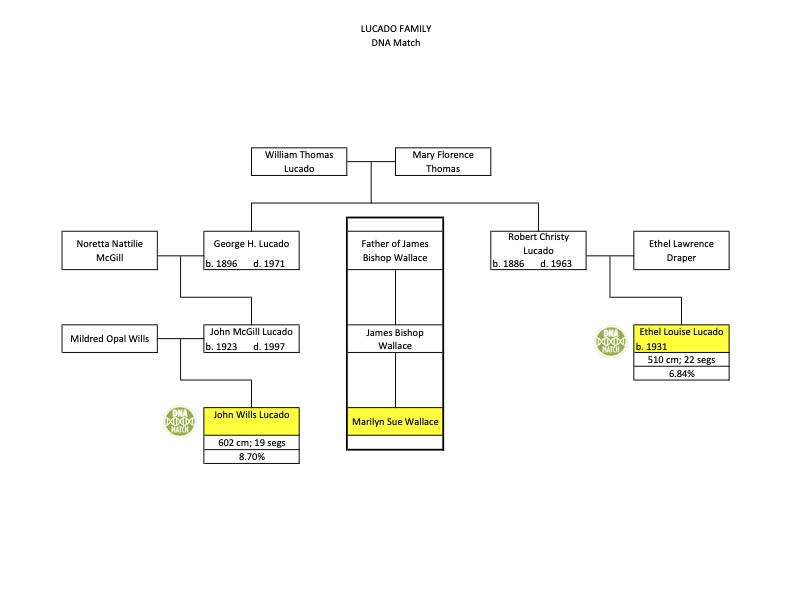
Using the DNA matches on Ancestry.com, I was able to pinpoint the individuals that connected to James’ family; both his his paternal and maternal sides. Focusing only on James’ paternal side, I located a gentleman that connected to Marilyn as her half first cousin. That means, this man’s father is James’ half brother, and they share a father.
As you can see from this chart below, John Wills Lucado is Marilyn’s half first cousin. He is her closest DNA match on James paternal side. John’s father, John McGill Lucado, is James’ half-brother. Their father is George H. Lucado.
George Lucado was from Roanoke, Virginia and Helen House (James’ mother) was from Harlingen or San Antonio. So, how did the Lucado DNA from Virginia get to Texas to create James Bishop Wallace?
George Goes To Texas
Helen House was born July 1, 1897, in Grand Junction, Greene County, Iowa to Dennis Charles House and Margaret Ellen Brewer. The House family moved to Harlingen, Texas from Oklahoma sometime between 1910 and 1915.
George H. Lucado was born January 23, 1896, in Glasgow, Rockbridge County, Virginia to William Thomas Lucado and Mary Florence Thomas.
He enlisted in the U.S. Army on June 13, 1914, and was assigned to the 12th Cavalry after basic training, which was ordered to the lower Rio Grande Valley in Texas and garrisoned at San Bonito, Harlingen, Mercedes, and Donna due to Mexican bandit raids into Texas.
George’s unit, Troop B, was assigned to Harlingen. George was based in Harlingen from August 1914 to February 1916, when the 12th Cavalry shipped out on the U.S. Army Transport “Kilpatrick” to Corozal, Canal Zone Panama as part of the military mobilization for the defense of the canal. The “Kilpatrick” arrived in the Canal Zone on February 29, 1916.

From The Canal Record, page 240;
“Arrival of Cavalry on the “Kilpatrick.” The First Squadron of the Twelfth Cavalry arrived at Cristobal from Galveston in the morning of Tuesday, February 29, on board the Army transport Kilpatrick. This is the first command of cavalry to have come to the Isthmus. It will be part of the permanent garrison and will be stationed at Corozal. Aboard the Kilpatrick were 15 officers and 294 men, 297 horses and 37 mules, nine wagons, 12 cars of baggage, and 400 tons of cargo. Upon completing the discharge of the cavalry, the Kilpatrick will sail for Galveston to bring the Second Battalion of the Fourth Field Artillery to the Canal Zone. This will be the first command of field artillery to come to the Isthmus.”
Family Connection
Earl Bittner enlisted in the U.S. Army on April 24, 1914, and was assigned to the 12th Cavalry garrisoned in Harlingen, Texas.
George Lucado and Earl Bittner served together beginning in basic training in August 1914, and throughout the time the 12th Cavalry was garrisoned in Harlingen. They remained in the same unit together while the unit was in the Canal Zone until December 1916, when George was transferred to the Quartermaster Corp.
Helen’s sister, Marie House, married Earl Robb Bittner on November 25, 1915, in Hidalgo County, Texas. Their son, Thomas James, was born in February 1916, just two weeks after Earl was sent to the Canal Zone. They divorced within a couple of years after Thomas was born.
George Lucado and Earl Bittner served together in the same unit for almost three years. There is no doubt they were acquainted. They had relationships with sisters, Helen and Marie House, while they were based in Harlingen, Texas.
Helen became pregnant with George’s baby (James/Jack) approximately a month before George was sent to the Canal Zone. Did she know she was pregnant before George left?
Marie gave birth to Earl’s baby (Thomas James) approximately two weeks after Earl was sent to the Canal Zone. Did Marie relay a message to Earl to let George know that Helen was pregnant? There is no indication that George knew Helen gave birth to his baby (James/Jack); however, due to the relationship between the four individuals involved, there is a good possibility George knew about Helen’s pregnancy.
After…
George remained in the Canal Zone until June 4, 1920, when he was discharged from the Army. He returned to Virginia after he was discharged and there is no indication he returned to Texas or made contact with Helen after he was discharged.
James would have been almost four years old at this time.
Helen House married Henry B. Wallace in 1924, in San Antonio, Texas. On the death certificate for Helen’s mother, Margaret Brewer, the informant is listed as “Mrs. H.B. Wallace”. Margaret died January 23, 1925; therefore, Helen and Henry were married before this date. No record of their marriage has been located.
In 1929, Helen and Henry were living in San Antonio at 1823-1/2 Rogers Street. Henry’s occupation was salesman. Jack was not living with them.
By March 1940, Helen was living in California with her sister, Irene, and Henry was committed to the VA Neuro-Psychiatric Hospital in Waco, Texas where he died November 25, 1941. He was diagnosed with “psychosis with psychopathic personality.” His death certificate indicates he was divorced at the time of his death.
Helen died December 4, 1958, at Santa Rosa Hospital in San Antonio, Texas, cause of death cardiac decompensation. She is buried at San Fernando Cemetery #2 in San Antonio.
George married Norretta Nattilie McGill on February 15, 1921, in Roanoke, Virginia. He was employed as an electrician. They had a son, John McGill Lucado, in 1923. This is James’ half-brother. George and his family remained in Roanoke, Virginia until about 1928, when they moved to Raleigh County, West Virginia. George remained in West Virginia until his death on September 19, 1971.
From his obituary, “He died at home at 8:30 p.m. after a long illness. Operated a grocery store and was postmaster at Pemberton for many years. He was a veteran of WWI and served on the Eunice draft board during WWII.”
George’s Military Service
George’s service in the 12th Cavalry Regiment during 1914 places him at a pivotal moment in U.S. military history, just before the full onset of World War I. His journey from Harlingen, Texas to the Panama Canal Zone reflects both domestic unrest and America’s growing global presence.
Their mission was border patrol during a volatile period of the Mexican Revolution, which spilled over into Texas through raids and unrest. George likely participated in mounted patrols, scouting for bandits and protecting local communities. Life was rugged: long days in the saddle, harsh weather, and limited supplies. But camaraderie and discipline were strong.
After border duty, the 1st Squadron was reassigned to Corozal in the Canal Zone, where they remained until 1921. The Panama Canal had just been completed in 1914, and the U.S. was responsible for its defense and administration. The 12th Cavalry’s role was to secure the canal, patrol its perimeter, and train for tropical operations. Corozal was a strategic post—lush, humid, and buzzing with international activity. Soldiers lived in barracks, trained in jungle conditions, and guarded one of the most important engineering feats of the century. George may have witnessed the canal’s early operations, seen ships from around the world, and interacted with workers and engineers from diverse backgrounds.
In 1915, George attended the School For Bakers and Cooks at Fort Riley, Kansas. George’s time at the school places him at the heart of a quiet but crucial revolution in military life: the professionalization of food service. This wasn’t just about baking bread—it was about keeping soldiers alive, healthy, and ready, especially in remote or rugged postings like the border or the Canal Zone. By this time, the school had become a cornerstone of Army logistics. It was created in response to the devastating realization during earlier conflicts—like the Spanish-American War—that more soldiers died from poor nutrition and food-borne illness than from combat.
While in the Canal Zone, George was attached to the Military Survey of Panama that was launched in 1916 and was a massive and strategically vital effort by the U.S. Army Corps of Engineers to map the terrain surrounding the Panama Canal Zone. Its goal: to prepare for the defense of the canal in case of foreign attack—a very real concern in the wake of World War I and rising global tensions. Survey teams operated in remote jungle conditions, often moving by pack mule and setting up camps in areas with limited water and space. It could take a week or more to relocate a company and resume mapping, due to the difficulty of terrain and logistics. The dry season was preferred for fieldwork, but even then, water scarcity and disease were constant challenges. The survey extended the Canal triangulation system into surrounding territory, creating one of the most detailed military cartographic records of its time. It helped transform the Canal Zone into a fortified military district, with installations like Quarry Heights and Fort Clayton relying on this data for defense planning.
Timeline of George Lucado’s military service (1914 to 1920)
| Date | Location | Unit | Rank | Notes |
| 06/15/14 | Enlistment | |||
| 06/30/14 | Columbus Barracks, Ohio | 22nd Recruit Company, General Service Infantry | Recruit | |
| 07/23/14 | Harlingen, Texas | 12th Cavalry | Recruit | Transferred from Columbus Barracks |
| 07/26/14 | Harlingen, Texas | 12th Cavalry; Troop B | Private | Joined by assignment |
| 08/31/14 | Harlingen, Texas | 12th Cavalry; Troop B | Private | |
| 12/02/14 | Harlingen, Texas | 12th Cavalry; Troop B | Cook | Appointed cook from private |
| 02/28/15 | Harlingen, Texas | 12th Cavalry; Troop B | Cook | |
| 03/01/15 | Harlingen, Texas | 12th Cavalry; Troop B | Private | Released from cook to private |
| 04/01/15 | Harlingen, Texas | 12th Cavalry; Troop B | Cook | Appointed cook from private |
| 06/11/15 | Fort Riley, Kansas | School for Bakers and Cooks | Private | Joined school; will forfeit 2/3 of monthly pay for 2 months |
| 08/31/15 | Fort Riley, Kansas | School for Bakers and Cooks | Private | |
| 10/16/15 | 12th Cavalry; Troop B | Private | Transferred back to Troop B, 12th Cavalry | |
| 10/20/15 | Donna, Texas | 12th Cavalry; Troop B | Private | Returned from Fort Riley, Kansas |
| 10/23/15 | Donna, Texas | 12th Cavalry; Troop B | Cook | Appointed cook from private |
| 10/31/15 | Donna, Texas | 12th Cavalry; Troop B | Cook | |
| 12/31/15 | Donna, Texas | 12th Cavalry; Troop B | Cook | |
| 02/29/16 | Cristobal Harbor, Panama Canal Zone | 12th Cavalry; Troop B | Cook | |
| 04/30/16 | Corozal, Panama Canal Zone | 12th Cavalry; Troop B | Cook | |
| 06/26/16 | Corozal, Panama Canal Zone | 12th Cavalry; Troop B | Private | Released from cook to private |
| 08/31/16 | Corozal, Panama Canal Zone | 12th Cavalry; Troop B | Private | |
| 10/31/16 | Corozal, Panama Canal Zone | 12th Cavalry; Troop B | Private | |
| 11/04/16 | Ancon, Panama Canal Zone | 12th Cavalry; Troop B | Private | |
| 12/31/16 | Corozal, Panama Canal Zone | 12th Cavalry; Troop B | Private | |
| 01/09/17 | Corozal, Panama Canal Zone | 12th Cavalry; Troop B | Private | Transferred to Quartermaster Corp |
| 01/12/17 | Corozal, Panama Canal Zone | Quartermaster Corp | Cook | Transferred from Troop B, 12th Cavalray |
| 01/13/17 | Ancon, Panama Canal Zone | Quartermaster Corp | Cook | Appointed cook from private |
| 02/14/17 | Republic of Panama | Quartermaster Corp | Cook | On Detached Service in Republic of Panama |
| 05/05/17 | Corozal, Panama Canal Zone | Quartermaster Corp | Cook | Rejoined unit from Detached Service |
| 08/31/17 | Corozal, Panama Canal Zone | Quartermaster Corp | Cook | |
| 10/31/17 | Corozal, Panama Canal Zone | Quartermaster Corp | Cook | |
| 11/25/17 | Panama Canal Zone | Military Survey of Panama | Cook | Transferred from Quartermaster Corp to Military Survey of Panama |
| 12/06/17 | Panama Canal Zone | Military Survey of Panama | Cook | On Detached Service in Republic of Panama |
| 02/06/18 | Panama Canal Zone | Military Survey of Panama | Cook | Released from Detached Service in Republic of Panama |
| 04/19/18 | Panama Canal Zone | Military Survey of Panama | Cook | On Detached Service in Republic of Panama |
| 04/23/18 | Furlough in the US | |||
| 05/01/18 | Corozal, Panama Canal Zone | Quartermaster Corp | Cook | Transferred from Military Survey of Panama to Quartermaster Corp |
| 06/15/18 | 2nd Enlistment | |||
| 06/30/18 | Corozal, Panama Canal Zone | Quartermaster Corp | Cook | |
| 07/31/18 | Corozal, Panama Canal Zone | Quartermaster Corp | Cook | |
| 09/30/18 | Corozal, Panama Canal Zone | Quartermaster Corp | Cook | |
| 10/31/18 | Corozal, Panama Canal Zone | Quartermaster Corp | Cook | |
| 11/30/18 | Corozal, Panama Canal Zone | Quartermaster Corp | Cook | |
| 12/31/18 | Corozal, Panama Canal Zone | Quartermaster Corp | Cook | Student Mess Sgt |
| 01/31/19 | Corozal, Panama Canal Zone | Quartermaster Corp | Corporal | Clerk |
| 02/28/19 | Corozal, Panama Canal Zone | Quartermaster Corp | Corporal | Clerk; sick in hospital |
| 03/31/19 | Corozal, Panama Canal Zone | Quartermaster Corp | Corporal | School teacher |
| 04/30/19 | Corozal, Panama Canal Zone | Quartermaster Corp | Corporal | School teacher |
| 05/31/19 | Corozal, Panama Canal Zone | Quartermaster Corp | Corporal | School teacher |
| 06/30/19 | Corozal, Panama Canal Zone | Quartermaster Corp | Corporal | School teacher |
| 08/31/19 | Corozal, Panama Canal Zone | Quartermaster Corp | Corporal | School teacher |
| 09/30/19 | Corozal, Panama Canal Zone | Quartermaster Corp | Corporal | School teacher |
| 10/31/19 | Corozal, Panama Canal Zone | Quartermaster Corp | Corporal | School teacher |
| 11/30/19 | Corozal, Panama Canal Zone | Quartermaster Corp | Corporal | School teacher |
| 12/31/19 | Corozal, Panama Canal Zone | Quartermaster Corp | Corporal | School teacher |
| 01/31/20 | Corozal, Panama Canal Zone | Quartermaster Corp | Corporal | School teacher |
| 02/29/20 | Corozal, Panama Canal Zone | Quartermaster Corp | Corporal | School teacher |
| 03/17/20 | Camp Dix, New Jersey | Corporal | Transferred to Casual Camp for furlough to Reserves |
 A Little Bit About Something